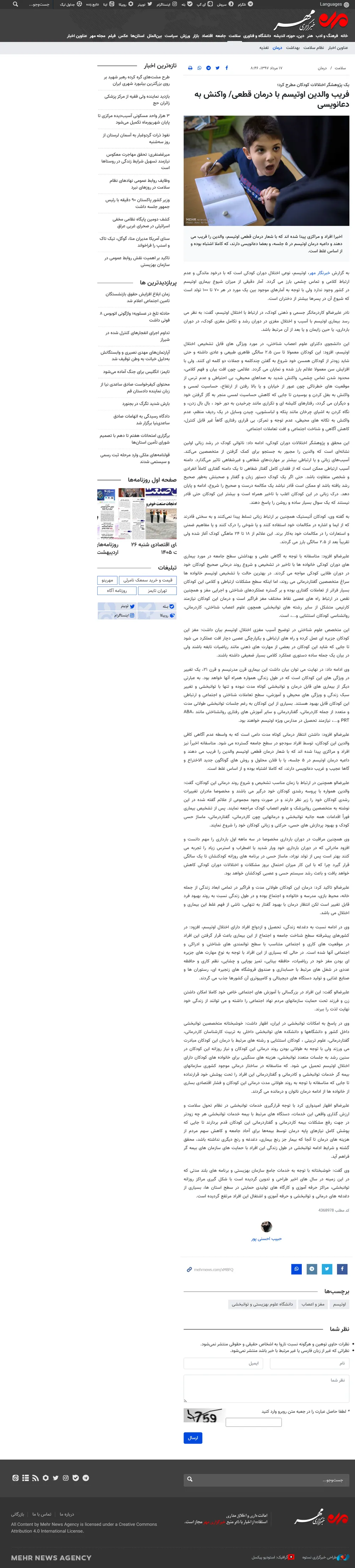
Centres claiming to cure autism in a few sessions — some through prayer writing and other superstitious methods — are misleading families with false promises. Estimated prevalence is 1 in every 70 to 100 births.
Recently, certain individuals and centers have emerged claiming to “cure autism” within just a few sessions, or even through superstitious methods such as prayer writing, misleading families with false promises. These claims are entirely incorrect and fundamentally flawed.
According to Mehr News Agency, autism is a childhood neurodevelopmental disorder characterized by social withdrawal, impaired verbal communication, and reduced eye contact. While precise national statistics are lacking, current estimates suggest a prevalence rate of 1 in every 70 to 100 births, with a higher incidence among boys than girls.
Dr. Nader Alirezaloo, pediatric occupational therapist and PhD candidate in Cognitive Neuroscience, explained that autism is likely associated with brain dysfunction or developmental disturbances occurring during pregnancy, childbirth, or early postnatal stages.
He noted that children with autism may initially appear to develop typically up to around 2.5 years of age, sometimes even speaking earlier than peers. However, with age, symptoms gradually emerge, including: decline in verbal expression and comprehension, reduced eye contact, heightened sensitivity to environmental sounds, lack of fear in dangerous situations (such as crossing the street or climbing heights), tactile sensitivity or aversion to touch and affection (sometimes leading to self-biting), stereotyped and repetitive behaviors such as spinning, hand-flapping, fascination with rotating objects (fans, washing machines), lining up toys in strict order, poor response to stimuli, inattention, hyperactivity, reduced social awareness, and impaired social interactions.
Dr. Alirezaloo emphasized that delayed language development is often the first sign prompting parents to seek professional help. Communication impairments may range from complete absence of speech to highly restricted, idiosyncratic language. Even children with seemingly proper grammar and vocabulary may struggle to initiate, maintain, or conclude conversations. Comprehension is frequently delayed, with many unable to answer even simple questions. Additionally, difficulties with gestures, humor, figurative speech, and nonverbal communication are common, with symptoms typically becoming more pronounced after 2.5 years of age.
He warned that many families, due to limited awareness, delay seeking proper treatment during the “golden years” of childhood development. Autism is not limited to speech and language deficits; it involves broader impairments in cognitive and executive functioning, as well as disrupted neural connectivity. Effective intervention therefore requires a multidisciplinary team, including experts in cognitive neuroscience, occupational therapy, psychology, and special education.
“Autistic brains often function in an ‘island-like’ manner,” he explained, “with impaired connectivity. Some children may display extraordinary talent in areas like mathematics, yet struggle severely with simple grammatical speech.”
According to him, autism is a lifelong condition of the modern era and cannot be “cured” in the short term. With continuous rehabilitation, environmental adaptations, and specialized education, however, cognitive, social, and communication skills can improve significantly. Many children, despite undergoing extensive therapy such as occupational therapy, speech therapy, or behavioral approaches like ABA and PRT, may still require placement in specialized autism schools.
Dr. Alirezaloo criticized false claims of “short-term cures,” stating: “Unfortunately, due to parents’ limited awareness, opportunists exploit families by promising miraculous results with strange solutions, quick-fix therapies, or even superstitious practices like prayer writing. These are completely wrong and misleading.”
He further stressed the importance of early diagnosis and intervention, advising parents to monitor developmental changes closely and seek consultation from child psychiatrists and neuroscientists if multiple warning signs are present. Upon diagnosis, comprehensive interventions—including occupational therapy, speech therapy, sensory integration, and motor-language rehabilitation—should be initiated immediately.
He also highlighted the importance of maternal care during pregnancy, particularly in the first trimester, recommending sensory massage for infants up to one-year-old if mothers experienced severe stress or hyperemesis during pregnancy, as this may reduce future developmental risks.
Dr. Alirezaloo underscored that autism requires long-term, holistic rehabilitation across all aspects of life—home, school, play, and community. Expecting recovery based solely on speech therapy reflects a misunderstanding of the disorder.
In discussing the challenges faced by autistic individuals in adulthood, he noted that developed countries provide supportive work and social opportunities aligned with their unique abilities—such as accounting, retail, food industry, and digital technology—while ensuring social inclusion, family life, and marriage with proper support systems.
Regarding Iran’s rehabilitation resources, he acknowledged the expertise of local specialists and universities but criticized the lack of insurance coverage for occupational and speech therapy, which imposes heavy financial burdens on families. This financial strain often forces many to abandon treatment prematurely.
He expressed hope that with the integration of rehabilitation into the national health system and improved insurance coverage, families would gain better access to lifelong support, reducing the financial burden and ensuring continuity of therapy.
Finally, he praised the Welfare Organization’s recent efforts in establishing day rehabilitation centers, vocational training, and sheltered workshops across provinces, which have addressed many concerns related to therapy, education, and employment for individuals with autism.
Also published by · 6 agencies